
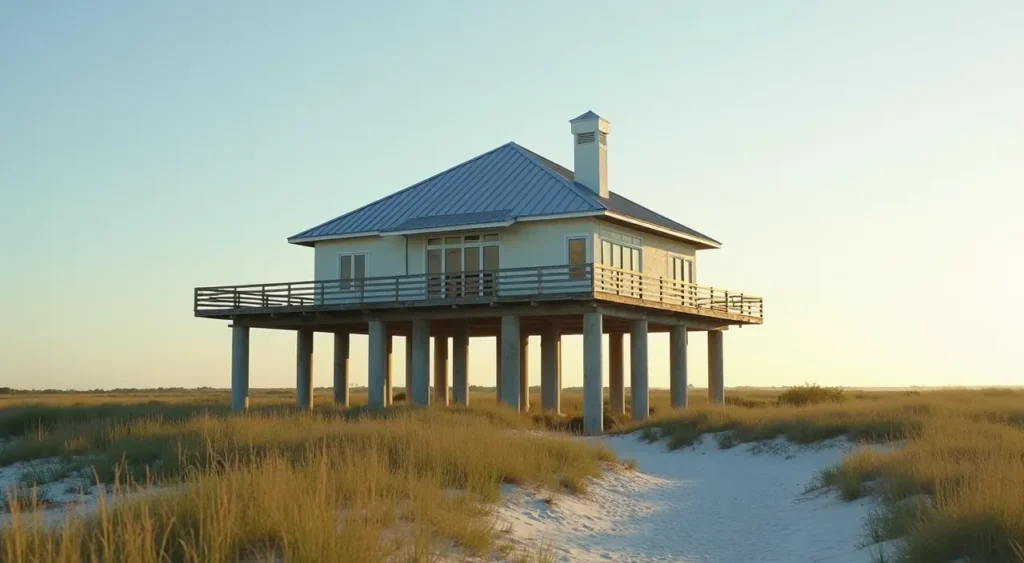
Under FEMA’s substantial improvement and substantial damage rules, if the cost to repair or improve a structure in a special flood hazard area equals or exceeds 50 percent of that structure’s market value, the entire building must be brought into compliance with current flood-resistant construction standards, which usually means elevating it. Local building departments enforce this at permit stage. It is the reason many Florida owners discover that a roof and drywall repair has become a rebuild on pilings.
What the rule actually says
The rule comes from the National Flood Insurance Program and is enforced by your local building department as a condition of the community’s participation in the program.
- Substantial improvement is any reconstruction, rehabilitation, addition or other improvement where the cost equals or exceeds 50 percent of the structure’s market value before the work starts.
- Substantial damage is damage of any origin where the cost to restore the structure to its pre-damaged condition equals or exceeds 50 percent of its market value before the damage.
Cross that threshold in a special flood hazard area and the whole structure must be brought up to current standards, which typically means the lowest floor has to be at or above the base flood elevation.
The two numbers that decide it
Market value of the structure, not the property. Land is excluded. This catches people out badly in Florida, where a waterfront lot can be worth far more than the modest house sitting on it. A 400,000 dollar property might have a 120,000 dollar structure, which makes the threshold 60,000 dollars of work rather than 200,000.
Cost of the work. Full cost of all materials and labor, including what you intend to do yourself, valued at what a contractor would charge. Communities also commonly apply a cumulative rule, adding up permitted work over a defined look-back period, so several smaller permits can trigger it collectively.
Why owners find out too late
The sequence is almost always the same. A storm damages the house. The owner gets contractor estimates. They apply for a permit. The building department reviews the estimate against the structure’s assessed or appraised value, determines the work is substantial, and the permit comes back requiring full compliance.
Elevating an existing slab-on-grade Florida house is extremely expensive and in some cases not practical at all. At that point owners face a very different decision from the one they thought they were making, often with a tarp already on the roof and insurance proceeds that assumed a straightforward repair.
What this means if you want to sell
A house in this position is difficult to sell conventionally. A financed buyer needs insurance, and a house with unrepaired flood or storm damage will not be bound. They also inherit the same permit problem you have.
Your realistic options are to fund the elevation or rebuild, to sell to a cash buyer who takes the problem on, or to demolish and sell the lot, which in some coastal Florida markets is worth more than a compromised structure anyway. We buy at all three stages, including cleared lots. See our page on selling a storm damaged Florida house.
ICC coverage is worth knowing about
Standard NFIP flood policies include Increased Cost of Compliance coverage, which can contribute toward the cost of elevating, relocating, demolishing or floodproofing a structure that the community has declared substantially damaged. It is limited and it has conditions, but many owners do not know it exists. Ask your flood carrier about ICC specifically, by name.
Questions
Frequently asked
Who decides my structure's market value?
The local floodplain administrator, typically using the property appraiser’s assessed structure value or an independent appraisal you provide. You can usually submit your own appraisal if you believe the assessed figure is low.
Does the rule apply outside flood zones?
The substantial improvement requirement applies to structures in special flood hazard areas. Outside those areas the trigger does not apply, though normal permitting still does.
Can I split the work into smaller permits?
Many Florida communities apply a cumulative look-back specifically to prevent that. Deliberately structuring work to evade the threshold can create serious problems.
What is an elevation certificate?
A document prepared by a surveyor showing your structure’s elevation relative to the base flood elevation. It affects flood insurance rating and it is central to any substantial improvement determination.