
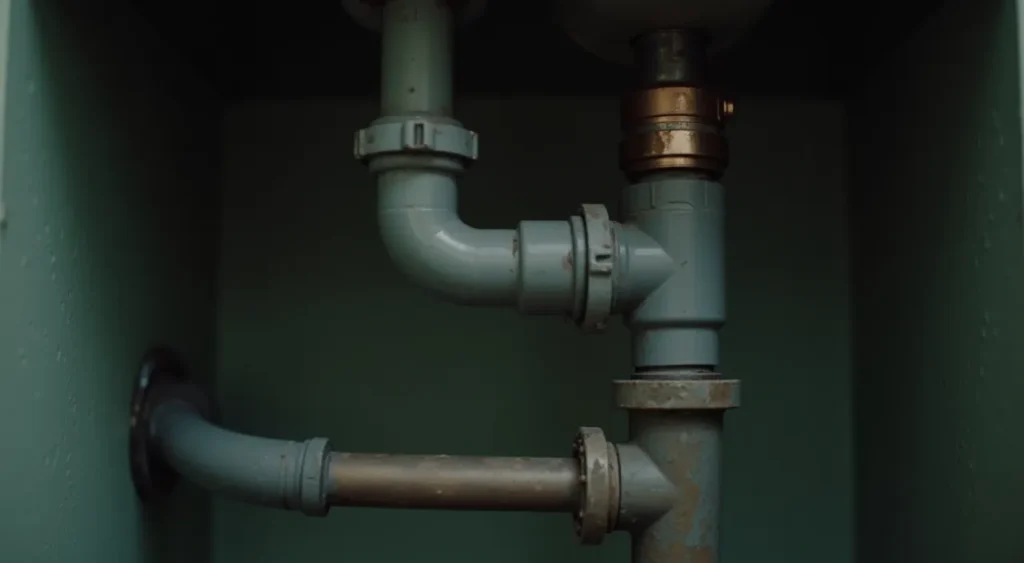
Three materials commonly found in Florida homes built between roughly 1965 and 1995 will often cause a carrier to decline coverage: polybutylene water supply lines, cast-iron drain and waste piping, and aluminum branch circuit wiring. None of them makes a house unsafe to live in today, but all three make it hard to insure, and a house that cannot be insured cannot be bought with a mortgage.
Polybutylene supply lines
What it is. A flexible plastic water supply pipe used widely from the late 1970s into the mid 1990s. Florida has a great deal of it because so much of the state was built during exactly that window.
How to identify it. Usually grey, sometimes blue or black, flexible rather than rigid, typically marked PB2110. Look at the pipe entering the water heater, at the main shutoff, and at stub-outs under sinks and behind toilets.
Why carriers care. It developed a reputation for failing at fittings and causing water damage claims. Whether any individual system will fail is genuinely uncertain, but insurers underwrite the category, not your specific pipe.
What it costs to fix. Repiping a typical Florida single-story house is a several-thousand-dollar job, more where the plumbing runs in the slab rather than the attic.
Cast-iron drain and waste piping
What it is. Cast-iron drain, waste and vent piping, standard in Florida construction into roughly the 1970s. Older neighborhoods in St. Petersburg, Tampa, Jacksonville, Miami and West Palm Beach are full of it.
How to identify it. Heavy dark metal pipe, often visible at cleanouts or in a crawl space. Tap it: it rings dull and solid rather than hollow.
Why it matters. Cast iron corrodes from the inside over decades. Failures tend to be under the slab, which means jackhammering floors to repair. Slow leaks under a slab also cause soil washout and can produce settlement.
Signs of trouble. Recurring backups, slow drains throughout the house rather than in one fixture, a sewage smell, damp or discolored flooring, or cracked tile in a line across a room.
Aluminum branch circuit wiring
What it is. Solid aluminum wire used for branch circuits, mainly between about 1965 and 1973 when copper prices spiked. It is distinct from the aluminum service entrance cable feeding the panel, which is normal, still used today, and not a problem.
How to identify it. The cable sheathing is usually marked AL or ALUMINUM. A licensed electrician can confirm at the panel and at outlets.
Why carriers care. Aluminum expands and contracts more than copper and oxidises differently, which can loosen connections at outlets and switches over time and create heat at the connection.
Remediation. Full rewiring is one option and it is expensive. Recognised repair methods that treat the connections, such as COPALUM crimps or approved AlumiConn connectors installed by a qualified electrician, are widely accepted by carriers at lower cost. Ask your insurer which methods they accept before paying for one.
What this means for selling
Any one of these can stop a financed sale. Together, which is common in a 1970s Florida house, they usually do.
You have three routes. Remediate before listing, which costs real money on a house you are leaving but restores the full buyer pool. Disclose and price accordingly, accepting a smaller pool. Or sell to a cash buyer, where insurability is the buyer’s problem after closing rather than a barrier to yours.
What does not work is hoping the inspector misses it. These are exactly the four items a Florida four-point inspection exists to find.
Questions
Frequently asked
Do I have to replace polybutylene before selling?
Not if you sell as-is or to a cash buyer. You will need to for most financed buyers, because their carrier will require it.
Is aluminum wiring dangerous?
Properly remediated connections are considered acceptable. Untouched original connections from that era deteriorate over time, which is why carriers and inspectors flag them.
How do I know if my drains are cast iron?
A plumber can scope the line with a camera for a modest fee, which also shows the actual internal condition rather than just the material.
Will a home warranty cover these?
Generally not. Home warranties typically exclude known pre-existing conditions and whole-system replacement of this kind.